
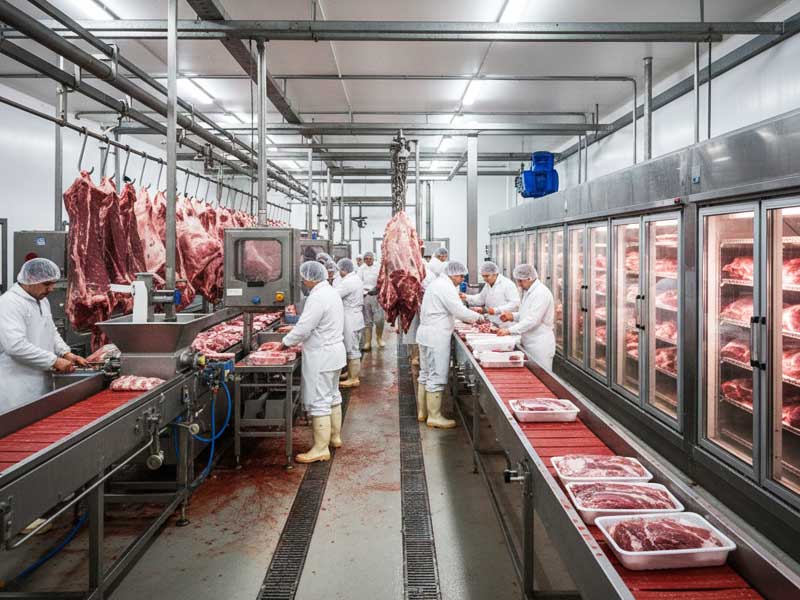
The meat processing equipment market reached USD 318.2 billion in 2024 and is projected to hit USD 429.1 billion by 2029. This growth reflects how critical the right machinery is for transforming raw livestock into safe, consumable products. The right commercial meat processing equipment for your meat processing facility can be overwhelming to choose when you evaluate different meat processing equipment manufacturers. We created this piece to walk you through equipment types, selection criteria and maintenance strategies that will help you build or optimize your processing operation.
What is Meat Processing Equipment?
Meat processing equipment has a wide range of machinery used to cut, grind, mix, cook and package meat products [1]. These specialized tools handle everything from original carcass breakdown to final product sealing. They support operations in butcher shops, grocery stores, delis and large-scale processing plants [2].
The machinery automates tasks that once required extensive manual labor. This boosts production efficiency while ensuring product consistency and quality [1]. Modern systems help facilities meet food safety regulations, reduce waste and lower labor costs [1]. Automation and robotics play a larger role in reducing processing time and improving hygiene as operations scale [1].
Most equipment features food-grade SUS304 stainless steel construction, which resists rust and simplifies sanitation [3]. Designs incorporate smooth, welded seams and sealed components that prevent bacteria from collecting in cracks [3]. This material choice ensures durability in demanding commercial environments where continuous use is standard.
Main Processing Equipment
These machines handle the original preparation of raw meat after slaughter [1]. Slaughtering equipment ensures humane and efficient animal processing. It meets regulatory standards through stunning systems, bleeding stations and evisceration lines [4]. These systems prioritize hygiene and minimize cross-contamination while maintaining speed [4].
Meat cutters and slicers break down carcasses into manageable cuts [1]. Automated or semi-automated cutting lines separate primal and subprimal cuts with precision after carcass chilling [4]. Band saws, trimming stations and deboning machines isolate high-value cuts while minimizing waste [4]. Commercial slicers produce uniform slices for deli meats, bacon and portioned proteins. This ensures consistent presentation [2].
Sharp cutting tools prove vital for faster and safer processing [5]. Dull equipment forces workers to apply excessive force, which increases injury risk [5].
Secondary Processing Equipment
These machines prepare meat for final products by transforming raw cuts into consumer-ready items [1]. Industrial meat grinders reduce meat into smaller, uniform particles [1]. Heavy-duty models feature powerful motors and large feed hoppers. They have multiple grinding plates for different consistencies [2].
Meat mixers and blenders ensure even distribution of spices, marinades and curing agents [1]. Commercial models use specialized paddles for full, consistent mixing in large batches [2]. Meat tumblers bring meat into a smoother state while tenderizing tougher cuts [6].
Sausage stuffers fill casings with portioned meat mixtures with precision [1]. These machines handle various casing sizes for consistent production [2]. Vacuum fillers help prevent air pockets in sausage and deli meats, improving shelf life [1]. Forming equipment creates uniform patties, meatballs and shaped products at high speeds [3].
Smoking and cooking equipment develops flavor while preserving products [1]. Smokers allow facilities to create cured meat products such as ham, bacon and jerky [5]. Curing chambers provide controlled environments for dry curing, smoking and aging specialty meats [2].
Packaging and Storage Equipment
Automated packaging machines ensure proper sealing and portioning of products [1]. Vacuum sealed packaging removes air from barrier packaging. This extends shelf life, maintains freshness and prevents freezer burn [7]. Chamber vacuum sealers handle individual bags for both intact and non-intact cuts [8].
Roll stock machines automate the forming, filling and sealing of packages for high-volume, retail-ready products [8]. Modified Atmosphere Packaging (MAP) replaces air with a gas mixture to inhibit microbial growth and slow oxidation. The mixture contains oxygen, carbon dioxide and nitrogen [7].
Refrigeration and freezer units maintain appropriate temperatures to prevent spoiling and harmful bacteria growth [5]. Walk-in refrigerators and freezers serve as the backbone of storage systems in meat processing facilities [6]. Industrial cooling systems have blast chillers for rapid temperature reduction and spiral freezers for continuous-line freezing. Plate freezers handle flat-packed products [4].
Essential Commercial Meat Processing Equipment for Your Facility
A functional meat processing facility needs careful equipment selection at multiple processing stages. Each piece serves a specific purpose in transforming livestock into market-ready products while maintaining safety standards and operational efficiency.
Slaughtering and Stunning Equipment
Stunning systems render animals unconscious before slaughter and prevent suffering during cutting and bleeding procedures [9]. The outcome depends on proper equipment selection, trained operators and manufacturer-specified maintenance protocols [9].
Mechanical stunning produces a brain state incompatible with consciousness until bleeding occurs [9]. Captive bolt systems use compressed air, gunpowder or spring tension and drive bolts against or through the skull [9]. Penetrative models create unconsciousness through concussive impact combined with brain tissue damage from bolt penetration [9]. Non-penetrating versions rely on impact force alone and work best with young animals weighing less than 10kg [9].
Electrical stunning interrupts normal brain activity by passing current through the animal’s head [9]. Head-only systems create reversible stunning and require bleeding within 15 seconds for most species [9]. Head-to-body configurations deliver current to both brain and heart and induce cardiac arrest for irreversible results [10]. Equipment for pigs places electrodes below the ears for stunning, then applies a chest electrode for cardiac fibrillation [10].
Cutting and Deboning Tools
Frontmatec develops customized automation solutions covering the whole meat processing value chain, including cutting and deboning lines [11]. Hobart offers industrial-strength meat saws designed for consistent cuts with minimal downtime [11]. Provisur provides separation technology including rotary, belt and press systems for mechanical deboning [11]. Their Piranha RSBF separator converts 90-97% of bone collection material into quality ground meat [11].
Grinders and Mixers
Hobart meat choppers and grinders handle high-volume operations and eliminate meat mashing while retaining natural color and flavor [11]. Butcher Boy grinders range from tabletop TCA 22 models to AU-42 and AU-52 automatic feed units, with custom options featuring 1,000 to 2,000 pound hoppers and 8 to 11 inch grinding heads [11]. Weiler machinery from Provisur incorporates Dominator and Balanced Flow technologies for processing fresh and frozen materials [11].
Smokers and Curing Chambers
Smokehouses cure meat with lasting smoky flavor using various wood chips [11]. Products including ham, fish and beef benefit from smoking processes [11]. Meat curing chambers simplify aging with precise temperature, humidity and air speed controls [12]. Digital displays make monitoring conditions straightforward [12]. These units can shorten curing processes to as few as eleven days [12].
Vacuum Sealers and Packaging Machines
Henkelman vacuum systems prevent aerobic bacteria growth and extend shelf life without preservatives [11]. Vacuum-packed meat matures while retaining weight, flavor and aromas [11]. Heavy duty models operate up to 20 hours a day [11]. CRYOVAC brand systems offer high-speed continuous motion rotary configurations for medium to large protein processors [11]. Chamber machines deliver reliable vacuum performance with support from technical service teams [11].
Refrigeration and Freezer Units
Precise temperatures throughout processing prove critical for food safety and USDA compliance [12]. Systems support slaughterhouse chilling for rapid carcass cooling, temperature-controlled cutting rooms, blast freezing for fresh meat and sausages, and cold storage with tight temperature control [12]. Carcass aging coolers hold approximately 50 head or 100 sides of beef at 40,000 pounds capacity [12]. Finished goods coolers measure 12 feet wide by 50 feet long with self-contained refrigeration systems [12]. Ammonia compressors provide energy-efficient solutions for large-scale operations [12]. Blast freezers freeze products fast and maintain texture and quality [12]. IQF systems freeze individual items without clumping [12].
How to Choose the Right Equipment for Your Meat Processing Facility
Selecting equipment for your meat processing facility just needs a systematic approach that matches machinery capabilities to operational realities. Uninformed choices create bottlenecks, waste capital, and cause production delays that erode profit margins.
Think About Your Production Volume and Scale
Match equipment capacity to daily processing requirements. Countertop models and manual assist features work well for low-volume operations that process under 100 pounds daily [11]. Medium-volume facilities that handle 100-500 pounds daily need mid-range commercial models with automated features and standard capacities [11]. High-volume operations that exceed 500 pounds daily require industrial models built for continuous operation and maximum capacities [11].
Production estimates should account for peak hours, seasonal variations and future growth projections. A machine that meets current needs may become inadequate within months if you don’t factor expansion plans into purchasing decisions. Undersized equipment creates production bottlenecks. Oversized machinery wastes floor space and increases operational costs.
Think About Product Types and Specialization
Different products require different machinery. Facilities that produce sausages need stuffers and casings equipment. Operations focused on fresh cuts prioritize slicers and portion control systems. Equipment versatility matters when you process multiple meat types, from poultry to beef cuts.
Grinders, slicers and vacuum sealers each serve distinct purposes within processing operations [11]. Grinders turn large cuts into desired textures. Slicers produce uniform portions for retail, and sealers extend shelf life through proper packaging. Think about which products generate the most revenue and allocate equipment budgets that way.
Check Space and Layout Requirements
Verify electrical capacity before you purchase equipment. Standard machines operate on 110-120V power. Heavy-duty models need 208-240V, and industrial equipment requires three-phase power [11]. Countertop models occupy 2-4 square feet. Floor models need 6-20 square feet, and installations require adequate ventilation, floor drains and electrical access [11].
Physical layout planning prevents workflow inefficiencies. Cut out equipment templates and arrange them on flat surfaces to test configurations before you finalize floor plans. Adequate room for machinery and employees prevents safety hazards and cramped conditions.
Set Your Budget and ROI Expectations
Small to medium-sized plants spend USD 150,000 to USD 500,000 on equipment alone [11]. Entry-level machines cost USD 300-1,000. Mid-range commercial equipment runs USD 1,000-5,000, and premium industrial models exceed USD 5,000 [11]. Simple setups with a slicer and grinder range from USD 1,500-4,000. Mid-range stations with 4-5 pieces cost USD 5,000-15,000, and full processing lines start at USD 20,000 [11].
ROI calculations require looking beyond purchase prices. Factor in operating costs, maintenance expenses and equipment depreciation of 10-20% each year [11]. Labor savings of 2-4 hours daily, waste reduction of 10-25%, and menu expansion that increases revenue 15-30% contribute to payback periods of 6-18 months [11]. Energy-efficient grinders save up to 20% in electricity costs despite higher initial investments [11].
Working with Meat Processing Equipment Manufacturers
Partnerships with meat processing equipment manufacturers extend beyond original purchase transactions. These relationships determine how smoothly your facility operates, how fast problems get resolved, and whether your equipment investment delivers expected returns.
Key Factors When Selecting Manufacturers
Customization capabilities separate average suppliers from exceptional partners. BAK Food Equipment’s engineering team works with clients from original consultation through design and specification. They deliver hundreds of customized solutions nationwide [13]. Their development team designs systems tailored to specific processing needs and provides detailed drawings ahead of time. Facilities know where to arrange electrical drops, connectors, and ancillary services [13].
Friesla offers complete project design phases and system planning. They also provide site planning and USDA regulatory compliance support coupled with HACCP plan writing [12]. This level of involvement proves valuable when you launch new operations or expand existing ones.
Understanding Warranty and Service Support
Standard warranty coverage has one year of parts and labor [14]. Warranty terms vary substantially between manufacturers. Some offer extended coverage options, while others provide warranty management services that handle claims and coordinate repairs with manufacturers.
Responsive service support minimizes unexpected downtime. Equipment encounters problems over time. Dependable support becomes critical for maintaining operations. Phone diagnosis can prevent unnecessary service calls and expenses before you dispatch technicians.
Installation and Training Services
Installation by professionals ensures equipment functions from day one. BAK Food Equipment engineers aid final installation and position systems. They level equipment and connect necessary power and electronics [13]. Their experts start up equipment, test functionality, and verify everything runs [13].
Training concludes the installation experience. BAK Food Equipment trains staff on proper equipment use and even makes a batch of product with clients [13]. Friesla provides onsite butcher training and workflow optimization. They also implement HACCP plans to maximize product quality and operating efficiency [12]. Their technical team offers equipment setup assistance and management hardware implementation. They also provide personnel training [12].
Compliance and Certification Standards
Regulatory compliance shapes manufacturer selection for meat processing facilities. Equipment must meet USDA requirements and industry certifications. Friesla manufactures all equipment to meet USDA compliance requirements [12]. Their in-house USDA experts handle documentation required to become a USDA or state-inspected meat processor [12]. They lead the writing of FSIS-compliant Hazard Analysis Critical Control Point (HACCP) Plans and assist with applying for state or USDA Grant of Inspection [12].
Maintaining and Optimizing Your Processing Equipment
Equipment longevity in your meat processing facility depends entirely on how you maintain it after installation. Daily care and scheduled maintenance that you neglect will cause costly breakdowns, contamination risks, and shortened equipment lifespan.
Daily Cleaning and Sanitation Protocols
Sanitation Standard Operating Procedures (SSOPs) document the steps required to ensure proper sanitation throughout your facility [15]. Pre-operational SSOPs indicate how you clean and sanitize equipment before processing begins. You typically conduct this at the end of one work day to prepare for the next [15]. You must disassemble all equipment and remove product debris. Rinse with water, apply approved cleaner, and sanitize with approved sanitizer. Rinse with potable water before reassembling [16].
Operational SSOPs address cleaning during plant operations. This includes knives, surfaces, and protective clothing [15]. Team captains perform daily organoleptic sanitation inspections after pre-operational cleaning and record results on forms [16]. Equipment that fails examination requires you to repeat cleaning procedures. Retrain employees if the problem persists [16]. Cutting equipment requires scrapers to remove meat residue, blood, and fat deposits. Disassemble key components like blades for scrubbing with alkaline cleaning agents [11]. Immerse food-contacting components in hot water above 80°C for thorough sterilization [11].
Preventive Maintenance Schedules
Annual preventive maintenance programs typically include two inspections per year at USD 215.00 per visit for commercial meat grinders [17]. The core team handles complete disassembly and inspection of auger, knife, and grinding plates. They check for excessive wear, cracks, rust, or pitting [17]. Inspections cover motor housing for overheating and power cords for damage. Belt wear and tension, gearbox housing for lubricant leakage, and operational performance testing round out the checklist [17].
Common Equipment Issues and Solutions
Grinders begin underperforming because of dull knives and plates. Worn-out parts contribute to the decline [18]. The biggest problem with blade and plate dulling comes from running your grinder dry, so you must ensure proper lubrication [18]. Pin and bushing wear at the grinder’s head creates throughput problems if left unresolved [18]. Overfilling blenders to increase production extends load, discharge, and blend cycle times. This sacrifices accuracy and quality [18].
Upgrading vs Replacing Old Equipment
Replace equipment when repair costs exceed 50% of a new unit’s cost and the equipment nears its average lifespan [19]. Frequent breakdowns, declining efficiency, and escalating maintenance costs signal replacement needs [20]. Repair costs that exceed 30% of replacement cost but equipment that retains over 40% of its lifespan make repairing the smart choice [19].
Conclusion
Equipment decisions shape your facility’s profitability and operational efficiency for years to come. Choosing the right machinery requires balancing production needs and budget constraints. We’ve covered everything in equipment types, selection criteria, and maintenance strategies to guide your investment decisions.
Selecting manufacturing partners who provide customization and responsive support proves just as valuable. These relationships become critical assets when challenges arise.
Prioritize daily sanitation protocols and preventive maintenance schedules. Proper care extends equipment lifespan and protects your ROI. The right equipment paired with diligent maintenance positions your facility for sustained growth in this expanding market.
FAQs
Q1. What types of equipment are essential for starting a meat processing facility? A functional meat processing facility requires equipment across multiple stages: slaughtering and stunning systems for humane animal processing, cutting and deboning tools for breaking down carcasses, grinders and mixers for creating ground products and sausages, vacuum sealers and packaging machines for extending shelf life, and refrigeration units for maintaining food safety temperatures. The specific equipment needed depends on your production volume, product types, and whether you’re running a small butcher shop or large-scale processing plant.
Q2. How much should I budget for commercial meat processing equipment? Equipment costs vary significantly based on scale and capabilities. Entry-level machines range from USD 300-1,000, mid-range commercial equipment costs USD 1,000-5,000, and premium industrial models exceed USD 5,000. A basic setup with a slicer and grinder typically costs USD 1,500-4,000, while small to medium-sized plants can expect to invest USD 150,000 to USD 500,000 for complete equipment packages. Most facilities see payback periods of 6-18 months through labor savings, waste reduction, and increased production capacity.
Q3. How often should meat processing equipment be cleaned and maintained? Daily cleaning is mandatory for all meat processing equipment. This includes disassembling equipment, removing product debris, applying approved cleaners and sanitizers, and rinsing with potable water before reassembly. Beyond daily sanitation, preventive maintenance should be conducted at least twice annually, including complete inspections of motors, blades, grinding plates, belts, and operational performance testing. Regular maintenance prevents costly breakdowns and extends equipment lifespan.
Q4. What should I look for when choosing a meat processing equipment manufacturer? Select manufacturers who offer customization capabilities to match your specific processing needs, provide comprehensive warranty coverage (typically one year minimum), and deliver responsive service support to minimize downtime. Look for partners who assist with professional installation, staff training, and regulatory compliance documentation. Manufacturers should help with USDA requirements, HACCP plan development, and provide ongoing technical support throughout your equipment’s operational life.
Q5. When should I replace meat processing equipment versus repairing it? Replace equipment when repair costs exceed 50% of a new unit’s cost and the machine nears the end of its average lifespan. Frequent breakdowns, declining efficiency, and escalating maintenance costs are clear replacement signals. However, if repair costs are under 30% of replacement cost and the equipment retains over 40% of its useful life, repairing remains the more economical choice. Equipment typically depreciates 10-20% annually, which should factor into your replacement decisions.
DAF UNITS APPLICATION FOR MEAT PROCESSING PLANTS
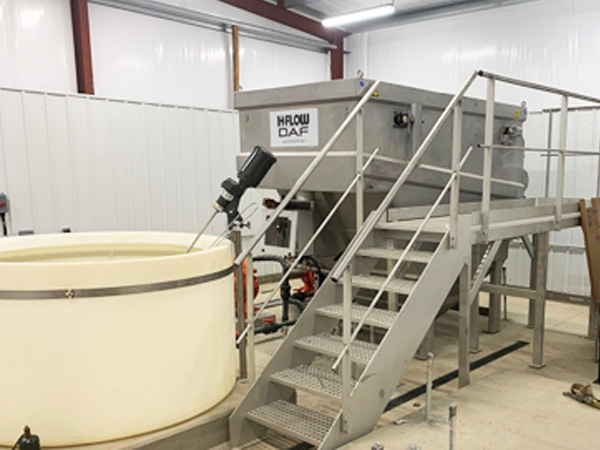
A DAF (Dissolved Air Flotation) unit is a mechanical clarification system used in industrial and municipal wastewater treatment to remove suspended solids, fats, oils, greases (FOG), and other insoluble contaminants from food processing.
It works by dissolving air into water under pressure, then releasing it into the wastewater. When the pressure drops, the dissolved air forms microbubbles that attach to particulate matter, making it float to the surface where it can be skimmed off as sludge.
Aqualitec provides advanced DAF systems engineered for meat processing plants with medium to high solids loading. Our Deltec, Gamtec and Sigtec DAF units combine compact design, durable stainless-steel construction, and innovative low-friction skimmer technology for reliable, low-maintenance performance.
Deltec DAF Units: Ideal for medium-polluted wastewater (COD up to 4,000 mg/l). Featuring the Platepack System, efficient sludge discharge by gravity, and a compact footprint, Delta units offer high separation performance with minimal maintenance. Units up to 150 m³/h are container-transportable.
Gamtec DAF Units: Designed for larger projects and higher flows (up to 1,000 m³/h), Gamma systems handle wastewater with COD up to 10,000 mg/l. Built with rectangular concrete tanks and Kemeo internals, they include optional bottom skimmers, efficient saturated water supply, and stainless-steel parts suitable for sea container transport.
With superior sludge removal, small footprint, and cost-effective operation, Aqualitec’s DAF units deliver reliable wastewater treatment solutions tailored for the food industry.
Need DAF Units for your Meat Processing Plant?
Call 855-650-2214 or Email us here
References
[1] – https://www.velecsystems.com/en/the-role-of-meat-processing-equipment-in-the-modern-food-industry/
[2] – https://www.gofoodservice.com/guides/meat-processing-equipment-buying-guide?srsltid=AfmBOopo2ZDoroTzdJ7z6BKBjvzOiOdcadjPcGQtehLZxszqPxVp2esp
[3] – https://byfoodmachinery.com/what-exactly-is-industrial-meat-processing-equipment/
[4] – https://kometos.com/news/buyers-guide-to-industrial-meat-processing-equipment/
[5] – https://blog.foodsafedrains.com/meat-processing-plant-equipment
[6] – https://www.chefsdeal.com/blog/butcher-shop-equipment-list?srsltid=AfmBOoqQcM7omn20PvVAC2155M-RcXOZm9_afxROmGcnNyL4yuzaFVra
[7] – https://uspackagingandwrapping.com/meat-packaging-buyer-s-guide.html?srsltid=AfmBOora9qlVR805cmszbC79xSxgRvig4d8aflzwUo2vjmCRaLVAkew4
[8] – https://friesla.com/blog/meat-packaging-101-equipment-strategies-independent-processors/
[9] – http://inspection.canada.ca/en/food-guidance-commodity/meat-products-and-food-animals/slaughter-methods-and-monitoring
[10] – https://www.hsa.org.uk/electrical-stunning-of-red-meat-animals-equipment/head-to-body
[11] – https://www.ihelpergroup.com/news/common-cleaning-methods-for-meat-processing-equipment-311857.html
[12] – https://friesla.com/services/
[13] – https://www.bakfoodequipment.com/warranty-and-service
[14] – https://pro-cut.us/warranty-service/
[15] – https://www.nichemeatprocessing.org/step-6-provide-a-written-standard-operating-procedure-for-sanitation/
[16] – https://www.fsis.usda.gov/sites/default/files/media_file/2020-08/Grant_of_Inspection_Attachment4.pdf
[17] – https://www.cityfoodequipment.com/pages/commercial-meat-grinder-preventative-maintenance-program?srsltid=AfmBOopHdEpKToJ3EoR4y7DRUchdIxY_9n9AjDR258HP7g8GEj6evsNr
[18] – https://www.mmequip.com/resource/common-issues-that-may-impact-meat-processing-efficiency-and-yield/
[19] – https://retailfoodequip.com/blogs/updates/lifecycle-commercial-food-processing-equipment
[20] – https://www.orbismachinery.com/when-to-consider-repair-replace-or-purchase